


In 2025, BISP payment distribution becomes more organized, verification focused, and service oriented. While many beneficiaries think payments are only about receiving cash, the real system behind smooth delivery depends heavily on Tehsil Offices. These offices act as the local bridge between beneficiaries and the program’s core database, making sure records stay accurate, verification stays fair, and payment issues get resolved quickly.
If you ever face a payment delay, see verification required, need a survey update, or want to correct your household information, the Tehsil Office is often the most practical and official place to fix the problem. This guide explains in simple terms how Tehsil Offices support BISP distribution across Pakistan, what services they provide, and how beneficiaries can use them to protect their eligibility and receive payments without stress.
Why Tehsil Offices Matter in the BISP Payment System
Tehsil Offices play a central role because BISP serves millions of households, and local support is necessary to manage records and resolve issues. A national system without local offices would leave beneficiaries confused and unsupported whenever a problem appears.
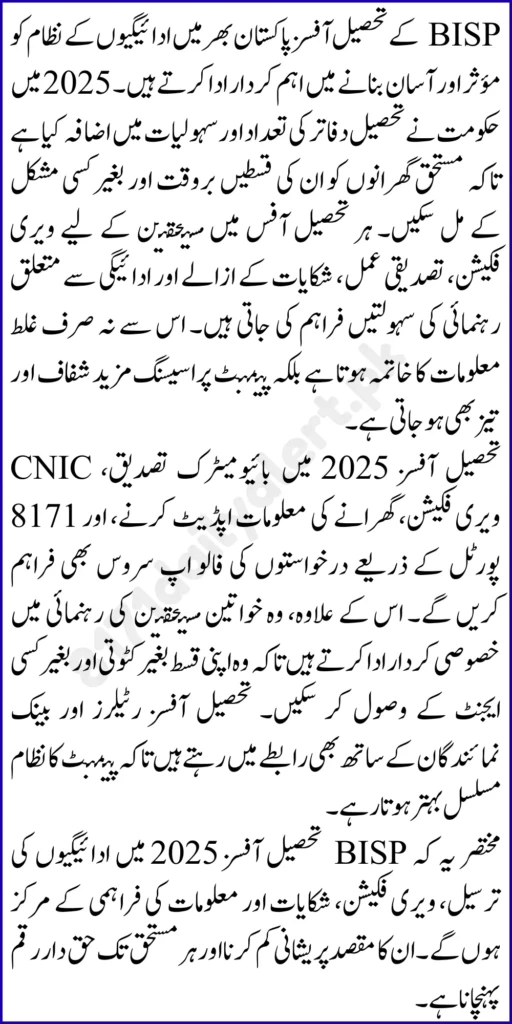
Tehsil Offices matter because they:
- Provide official assistance for BISP eligibility verification
- Help beneficiaries complete the NSER or dynamic survey update
- Fix errors in CNIC, family records, and household data
- Guide beneficiaries on payment readiness and next steps
- Handle complaints about deductions, biometric issues, or missing payments
- Reduce reliance on middlemen and prevent fraud
In short, they keep the system human, not just digital.
Key Services Tehsil Offices Provide to Beneficiaries
A Tehsil Office is not only for registration. It supports different stages of the beneficiary journey, from first time survey to long term eligibility maintenance.
Here are the most important services:
- Household registration through survey entry
- Record correction for wrong CNIC, name spelling, or family details
- Eligibility guidance when you receive not eligible or verification pending
- Survey re enrollment for households that need updated scoring
- Complaint registration for payment deductions or misconduct
- Biometric issue guidance when fingerprints repeatedly fail
- Support for vulnerable groups such as widows and persons with disability
Knowing these services helps you visit with a clear purpose and save time.
How Tehsil Offices Help During Payment Distribution Cycles
During active payment cycles, Tehsil Offices help beneficiaries confirm readiness and resolve blocked payments. This is especially useful when the system shows payment pending even though the beneficiary believes they qualify.
Tehsil Office support during payment cycles includes:
- Checking whether your record is active and verified
- Explaining why your 13,500 installment is delayed
- Identifying if your survey is outdated
- Confirming if your district cycle is active
- Guiding you to the right payment method and location
- Helping you file a complaint if you receive less than the due amount
For many families, this prevents repeated visits to payment centers without results.
Common Reasons People Visit Tehsil Offices in 2025
Beneficiaries usually visit Tehsil Offices for specific issues. Understanding these reasons helps you recognize when a visit is the smartest choice.
Common visit reasons include:
- Status shows verification required
- CNIC is updated but not reflected in the record
- Household changes such as marriage, birth, or separation
- Biometric mismatch continues at payment points
- Payment shows released but cash is not received
- Duplicate record conflicts within the family
- Survey required message appears after SMS check
These problems rarely resolve through guesswork. A Tehsil Office visit often solves them faster.
What to Bring When Visiting a Tehsil Office
Carrying the right documents is crucial because missing items can delay your case.
Bring:
- Original CNIC of the registered beneficiary
- CNICs of adult family members if available
- Children’s B forms if the issue relates to family listing
- Widow certificate or disability proof if applicable
- A working mobile number you can access
- Any SMS replies from 8171 saved on your phone
If you keep everything ready, most updates are smoother.
Comparison of Verification Methods
Tehsil Offices support multiple verification methods that determine eligibility and payment release. This table helps you understand how verification works and why Tehsil support matters.
| Verification Method | Purpose |
|---|---|
| CNIC Verification | Confirms identity and activates beneficiary record |
| Dynamic Survey Update | Updates household data to determine eligibility scoring |
| Biometric Verification | Confirms beneficiary identity during payment collection |
| SMS 8171 Status Check | Provides quick eligibility and payment readiness updates |
| Tehsil Office Manual Review | Resolves mismatches, duplicates, and complex record errors |
How Tehsil Offices Support Survey Updates and NSER Registration
Survey updates are essential in 2025 because household circumstances change. Tehsil Offices help ensure the survey reflects the current reality, which directly affects eligibility.
They support:
- New household data entry for first time registrants
- Updates for families whose status changes
- Corrections if the previous survey contains mistakes
- Re enrollment for beneficiaries who need updated assessment
- Guidance on what information matters most for accurate evaluation
This is why Tehsil Offices remain important even for families who already receive payments.
Kisan Card Reactivation 2025: Clear Dues Before Dec 15 to Stay Active
How Tehsil Offices Help Prevent Fraud and Deductions
Fraud often spreads when people rely on unofficial sources. Tehsil Offices reduce fraud by providing official guidance and complaint handling.
They help by:
- Explaining official payment procedures
- Helping beneficiaries avoid agents who demand fees
- Recording complaints about shop deductions or unfair behavior
- Guiding beneficiaries on proof collection such as receipts or messages
- Supporting secure verification through official steps
When beneficiaries use official offices, it becomes harder for scammers to exploit them.
Benazir Taleemi Wazaif January 2026 Payment Guide After Student Registration
What to Do If Your Payment Is Blocked or Delayed
If your payment does not arrive, Tehsil Offices usually diagnose the root issue. Before you visit, do a quick status check through 8171 to understand your current message.
Then the Tehsil Office can help with:
- CNIC update confirmation if expired or renewed
- Verification completion if pending
- Biometric guidance for repeated mismatch cases
- Survey correction if household data is incomplete
- Duplicate removal if multiple records exist
This structured approach is far better than repeated trips to payment points.
Required Documents for BISP 8171 December 2025 Payment Collection
Practical Tips to Get Faster Help at Tehsil Offices
To make your visit productive:
- Visit early in the day to avoid crowds
- Carry all original documents
- Write down your CNIC number and key issue on paper
- Take a screenshot of your 8171 SMS reply
- Be clear and calm when explaining your issue
- Confirm what action is taken before leaving
Small preparation turns a frustrating visit into a quick solution.
BISP 8171 Phase 3 Payment 2025: How to Get the 13,500 Installment
How Tehsil Offices Improve Payment Distribution Across Pakistan
Tehsil Offices improve distribution by keeping records accurate and beneficiaries informed. When fewer records contain errors, payments become smoother across the entire system.
They improve distribution by:
- Reducing verification failures
- Preventing repeated biometric issues through guidance
- Minimizing wrong or duplicate registrations
- Strengthening complaint handling and accountability
- Supporting better targeting so support reaches deserving households
This makes the system more fair and more reliable for everyone.
BISP 2025 Update: Camp Sites Closed, Payments Now Through Approved Shops
Final Words
In 2025, Tehsil Offices remain a vital part of BISP payment distribution across Pakistan. They do more than paperwork. They protect beneficiaries from errors, reduce payment delays, support survey updates, and provide official solutions when verification problems appear. If your payment is blocked, your status shows verification required, or your household information changes, visiting the Tehsil Office with proper documents is often the fastest and safest way to restore your eligibility and collect your 13,500 installment without stress.
FAQs
1. What is the main role of Tehsil Offices in BISP 2025?
They support verification, survey updates, record correction, and complaint handling to ensure smooth payments.
2. When should I visit a Tehsil Office for BISP issues?
Visit if your status shows verification required, survey required, payment blocked, or biometric problems continue.
3. Can Tehsil Office fix CNIC data mistakes?
Yes, they help correct record errors and guide updates after CNIC renewal or mismatch issues.
4. Do Tehsil Offices help with NSER or dynamic survey updates?
Yes, they support new registrations and survey updates that affect eligibility scoring.
5. What should I bring to a Tehsil Office visit?
Bring original CNIC, children’s B forms if needed, relevant certificates, and your 8171 SMS reply.
6. Can a Tehsil Office help if I receive less than 13,500?
They can register complaints, guide proof collection, and help you escalate issues through official channels.
7. How do Tehsil Offices reduce fraud?
They provide official guidance and complaints processing, which reduces reliance on agents and prevents scams.