


BISP Verification Restarted 2025: Fix Under Process Status and Get Paid. If your BISP status shows information under process or under verification, you are not alone. In 2025, the BISP verification process becomes more active and stricter because the program focuses on clean data, accurate targeting, and anti fraud controls. That is why many beneficiaries who receive payments earlier now see their records moved into review, and many new applicants remain stuck in processing for longer than expected.
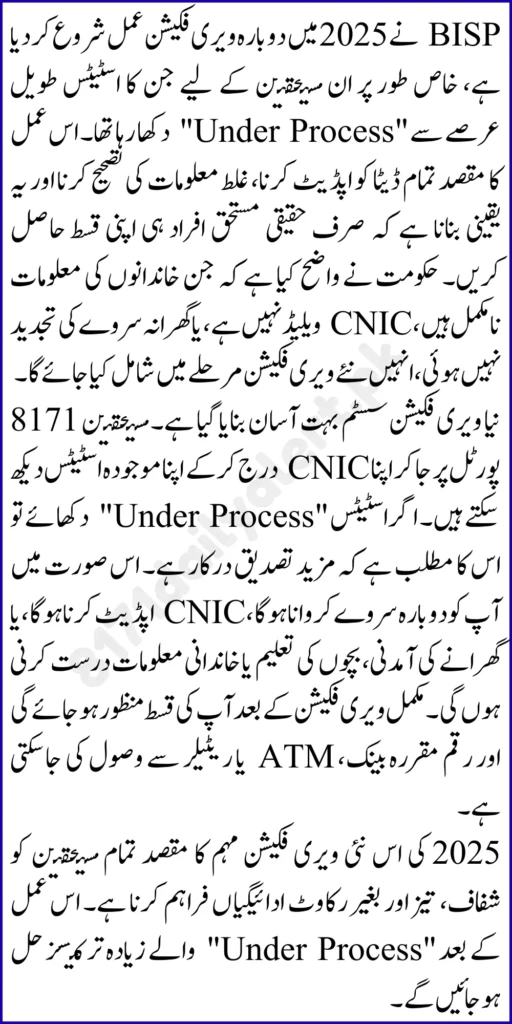
The good news is that the verification process is restarted for many people whose information is still under process. This guide explains the current situation in simple language. You will learn what “under process” actually means, why it happens, how to check your CNIC through 8171, what documents usually matter, and how to complete verification so your payments continue smoothly.
What “Information Under Process” Means in BISP
When your record shows under process, it usually means the system is actively reviewing your details instead of approving or rejecting you immediately. This can be a normal status during verification waves and data checking cycles.
Your case may show under process because:
- your household data needs confirmation
- your CNIC details require matching with official records
- your record is waiting for survey update processing
- the system detects a mismatch or duplicate risk
- your biometric verification needs confirmation
- your mobile number or family details are incomplete
This status is not a final decision. It is a signal that the system needs your information to be complete and verified before payments go forward.
Why BISP Restarts Verification and Data Cleansing in 2025
BISP keeps restarting verification because the aim is not only to pay money, but to pay the right people. In 2025, more checks happen because the system aims to remove wrong entries, correct outdated records, and stop illegal payments.
Verification restart helps achieve:
- better transparency in beneficiary selection
- stronger filtering of duplicate or fraudulent profiles
- updated targeting for families currently in financial need
- cleaner records for smooth payment disbursement
- fewer complaints and fewer payment disputes
Because of these changes, some old records are rechecked while new records are processed under stricter rules.
Who Is Most Affected by “Under Process” Status
Not every beneficiary faces the same problems. Some groups are more likely to be placed in under process status due to record complexity or repeated mismatches.
Under process commonly affects:
- families with old or incomplete NSER data
- beneficiaries with expired CNIC or changed marital status
- people who update household details recently
- cases with biometric failure at payment point
- profiles with duplicate entries or suspicious flags
- households with missing child records linked to stipends
If you fall into one of these categories, the system may require extra checks before approving payment.
How to Check Your BISP Status Through 8171 CNIC Verification
The most reliable step is to use the official 8171 CNIC check method. Checking your status before visiting any office saves time and travel cost.
A simple routine that works:
- keep your 13 digit CNIC number ready
- use the official 8171 method through SMS or portal checking
- read the message carefully and note the status line
- follow instructions for verification if shown
- check again after updates if your status remains pending
If your status flips between under process and verification pending, it usually means your record is moving through the checking phase.
Common Reasons Your Verification Gets Stuck
Many beneficiaries stay stuck because of small issues that feel harmless but matter in a verification system. Fixing these issues usually speeds up your case.
Common reasons include:
- CNIC expired or CNIC information mismatch
- wrong name spelling, wrong date of birth, or wrong family links
- outdated mobile number that does not receive alerts
- incomplete household data after survey changes
- biometric mismatch or fingerprint quality issues
- multiple applications from the same household
- missing B Form details for child related support
If you identify which reason fits your situation, you can take faster action.
What You Should Prepare Before Visiting Any Office
People waste time by visiting offices without preparation. If you go with complete information, your verification becomes easier.
Keep these ready:
- original CNIC of the beneficiary
- supporting family identity documents if needed
- proof of updated information such as new marital status entry
- child B Forms if you receive education stipend support
- active mobile number linked to your identity
- any previous receipts, tokens, or verification messages
Do not take photocopies only. Usually, original documents are important for confirmation.
Comparison of Verification Methods
| Method | Details |
|---|---|
| Official Program Website | Official guidance and updates: https://bisp.gov.pk |
| 8171 SMS CNIC Check | Send CNIC to 8171 for basic status and eligibility message |
| 8171 Web Portal | Online CNIC validation for under process and verification updates |
| Biometric Verification | Fingerprint confirmation at payment point for secure disbursement |
| Local Office Support | Record correction, survey update help, and complaint registration |
Step by Step: How to Clear Under Process Status Faster
While every case is different, most under process records clear when you complete basic identity matching and correct the data.
Practical steps that usually help:
- renew CNIC if it is expired
- correct name spelling and family links if mismatched
- update your mobile number if inactive
- complete any required biometric confirmation properly
- ensure household information reflects current reality
- submit child B Forms if you receive any education stipend
- avoid multiple applications from the same home
After updates, the system usually needs time to refresh, so your portal message may change after the next update cycle.
Biometric Verification Issues and How to Solve Them
Biometric failure is one of the biggest reasons payments stop even for eligible families. In 2025, biometric verification stays an important security step.
To improve biometric success:
- wash hands and dry them properly before scanning
- avoid lotion or oil right before verification
- try alternate fingers if permitted
- ask the operator to clean the scanner surface
- if it still fails repeatedly, update biometrics through the proper official process
Biometric verification protects your payment from being taken by someone else, so it is strict by design.
What If Your Status Shows Payment Collected but You Receive Nothing
This is a serious issue. If your portal or message shows payment collected but you did not receive cash, do not ignore it. This is usually linked to misreporting, misuse, or system entry error.
What you should do:
- visit the nearest support office with your original CNIC
- explain that status shows payment collected but money is not given
- request a complaint entry and keep reference proof
- avoid going through agents or middlemen
- do not pay any fee just to register a complaint
Fast reporting improves the chance of recovery and prevents repeated misuse.
How to Avoid Fraud and Deductions During Collection
Whenever verification restarts, scammers become active. They claim they can clear your status or speed up approval for money. This is risky and unnecessary.
Stay safe by following:
- do not share CNIC photos or personal details with strangers
- do not pay anyone to change your eligibility
- always confirm the exact payment amount before leaving
- count money on the counter, not at home
- collect only from authorized payment points
- keep your SMS and receipts saved
If someone tries to deduct money, report it immediately at the same location.
Why Keeping Your Mobile Number Updated Matters in 2025
BISP relies heavily on communication. If your number is inactive, you miss important alerts, verification instructions, and complaint updates. This can keep your case stuck for longer.
An active number helps you:
- receive messages about verification requirements
- track payment timing and installment readiness
- get notice if your record needs updates
- follow complaint progress without repeated visits
A correct mobile number reduces confusion and improves your control over your own case.
What Happens After Verification Clears
Once your verification clears, your status usually changes to eligible or payment ready. After that, you can collect through the correct channel with biometric confirmation.
After clearance, you commonly see:
- eligibility confirmation through 8171
- payment ready message when release begins
- smoother tracking through portal updates
- fewer interruptions in future cycles if data stays updated
To keep payments uninterrupted, maintain your records and respond quickly to verification instructions.
Final Words
The restarted BISP verification process in 2025 is meant to clean records, reduce fraud, and ensure that financial support reaches the right households. If your information shows under process, it usually means the system needs updated data, identity matching, or biometric confirmation before payments continue. The best approach is to use 8171 CNIC verification, keep your CNIC valid, update household and mobile details, and avoid agents who demand money. Most under process cases clear once your record becomes accurate and verified, and then payments restart smoothly.
FAQs
1) What does “information under process” mean in BISP?
It means your record is currently being reviewed, and verification is not completed yet. It is not a final rejection.
2) How do I check my under process status?
Use the official 8171 CNIC check through SMS or portal to see your latest status message.
3) Why does verification restart in 2025?
Verification restarts to improve transparency, remove fraud, and ensure support goes only to eligible and verified families.
4) What if my CNIC is expired?
Renew your CNIC first. Expired CNIC can stop verification and delay payments.
5) What should I do if biometric verification fails?
Wash and dry hands, retry with alternate fingers if allowed, and update biometrics through the official process if repeated failure continues.
6) What if the portal shows payment collected but I did not get money?
Report it immediately at the nearest support office with your CNIC and request complaint registration.
7) How can I avoid delays in the future?
Keep CNIC valid, keep household data updated, maintain an active mobile number, and use only official verification channels.