


Benazir Kafaalat 13500 Payment 2025 Phase 1 to 3 Latest Update. The Benazir Kafaalat Program continues to provide crucial financial relief to eligible families, and the new 13500 payment in 2025 remains one of the most searched updates across Pakistan. Many beneficiaries want clear answers about Phase 1, Phase 2, and Phase 3, including when payments release, how the 8171 CNIC check works, and what to do if the portal shows under verification or payment collected.
This guide explains the full picture in simple, human language. You will learn how phased payments work, what eligibility looks like in 2025, how to confirm installment status, and how to collect your money safely without deductions or fraud.
What the 13500 Kafaalat Payment Means in 2025
The Rs 13,500 quarterly installment is designed to support low income households facing rising prices of food, transport, and utilities. In 2025, the program focuses more on verification, data accuracy, and fair targeting, which means beneficiaries see more status updates in the system than before.
This payment typically supports:
- grocery and household essentials
- children’s school expenses
- basic healthcare and medicines
- transportation and daily living costs
The most important thing to understand is that payments now depend heavily on verified data. If your record is incomplete, you may face delays even if you received payments earlier.
Why Payments Release in Phase 1 to Phase 3
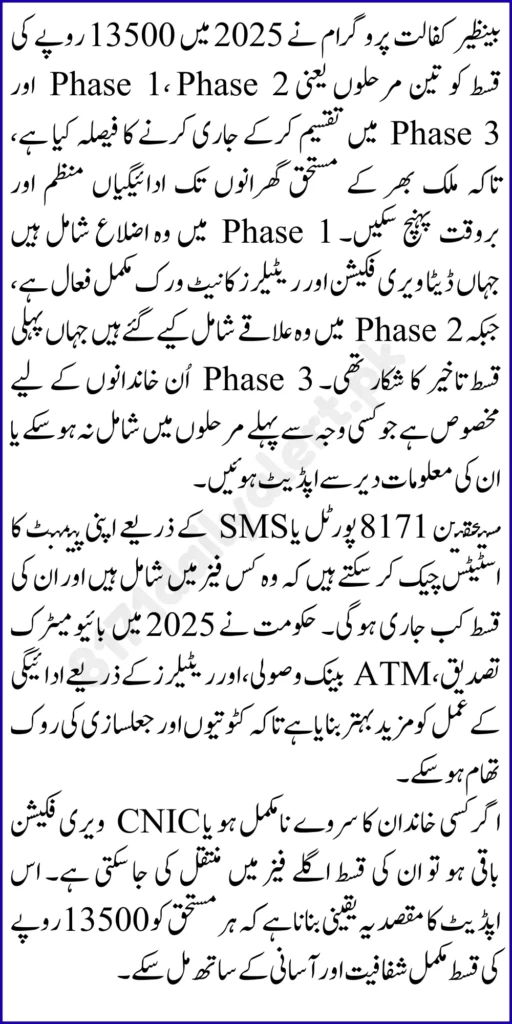
Phased payments help manage crowd control, reduce system load, and improve transparency at distribution points. When everyone receives money on one day, centers can become overcrowded and errors increase. The Phase 1 to Phase 3 structure makes the process smoother and safer.
Phased release helps by:
- preventing long lines and stampedes
- lowering pressure on payment systems
- improving biometric verification success rate
- reducing confusion for beneficiaries
- allowing targeted troubleshooting in each phase
This is why some families receive payments earlier while others receive them later, even within the same province.
Phase 1 Payment: What Beneficiaries Usually Experience
Phase 1 typically covers selected districts where systems are ready and verification records are already stable. Beneficiaries in Phase 1 often see faster updates, smoother payment checks, and fewer delays.
In Phase 1, you usually notice:
- quicker portal status updates
- faster release messages for eligible households
- better managed distribution points
- fewer blocked cases due to already verified data
If you are not in Phase 1, it does not mean you are rejected. It simply means your district or record is included in later release scheduling.
Phase 2 Payment: Why Some Cases Shift Here
Phase 2 often includes districts where service load is higher, where verification is ongoing, or where payment points need better crowd distribution. Many beneficiaries appear in Phase 2 after their status shows verified or after their record clears a pending check.
Phase 2 is common for:
- records recently updated through NSER
- beneficiaries with minor data corrections
- places with high population density
- areas where payment partners need staggered processing
If you are waiting, keep checking your status and avoid visiting centers repeatedly without an updated confirmation.
Phase 3 Payment: Who Falls Into This Category
Phase 3 generally includes districts or beneficiaries who require additional scheduling, follow up verification, or backlog adjustments. Some families appear in Phase 3 because their record needs a final check, biometrics require retry, or their profile is being matched again.
Phase 3 may include:
- cases marked under verification
- accounts previously blocked but now reactivated
- biometric mismatch cases that get resolved later
- beneficiaries eligible after new survey updates
The main point is that Phase 3 is still a normal part of rollout, not a rejection.
Eligibility in 2025: What Matters Most Right Now
In 2025, the system focuses strongly on eligibility proof through clean data and verified identity. Even long time beneficiaries may be asked to confirm records again.
Key eligibility signals include:
- valid CNIC that is not expired
- accurate household record in system
- no duplicate registration or conflicting data
- poverty scoring and financial need criteria
- successful biometric identity confirmation at payment time
If your CNIC is expired or your household data is outdated, you may not receive payment until correction is completed.
How to Check Your 13500 Payment Through 8171
Most beneficiaries use the 8171 web portal or 8171 SMS service as the official route to confirm eligibility and payment status. Checking your CNIC before visiting a payment point can save you time, travel cost, and frustration.
A practical checking routine:
- keep your CNIC number ready
- use the official 8171 method for status checking
- read the result carefully and note the status line
- if it shows eligible, follow collection instructions
- if it shows verification pending, focus on updates first
Knowing what your status means is as important as checking it.
Understanding Common 8171 Status Messages in 2025
Many people panic after seeing one line on the portal. Most messages are informational and guide you on the next step.
Common messages and meanings:
- Eligible means your payment is approved or processing
- Payment Ready means you can collect after verification
- Under Verification means your record is being checked
- Blocked means there is a mismatch or issue to resolve
- Payment Collected means the system marks payout as done, so report immediately if you did not receive cash
- Not Eligible means you currently do not meet criteria or your record needs review
If you see payment collected but you did not get money, do not wait. File a complaint quickly through proper support channels.
Comparison of Verification Methods
| Method | Details |
|---|---|
| Official Program Website | Use official guidance and updates: https://bisp.gov.pk |
| 8171 SMS CNIC Check | Use CNIC based SMS check to confirm basic eligibility and status |
| 8171 Web Portal Validation | Check payment phase status and verification messages online |
| Biometric Verification at Payment Point | Fingerprint confirmation is required to release Rs 13,500 |
| Tehsil Office Support | Visit for record corrections, blocked cases, and verification issues |
How to Collect the 13500 Payment Safely Without Deductions
Collection is where many families face issues, especially when they do not know their exact payment amount. The safest approach is to go prepared and stay alert.
Safe collection tips:
- carry original CNIC
- complete biometric verification yourself
- confirm the exact amount before leaving the counter
- count cash on the spot
- keep receipt or confirmation proof
- refuse any illegal deductions or agent fees
- avoid sharing personal information with strangers
If anyone demands a cut, report it immediately at the same location to official staff.
What Causes Delays, Blocks, and Deactivation in 2025
In 2025, delays happen mostly due to verification and data cleansing. This is not always bad. It often means the system is trying to remove fraud and ensure payments go to deserving households only.
Common reasons include:
- CNIC expired or record mismatch
- biometric failure or fingerprint issues
- household data not updated through recent survey
- duplicate records or suspected fraudulent activity
- mobile number inactive and missing verification alerts
- eligibility re evaluation due to updated scoring
The best solution is to keep your CNIC valid and your household data updated.
Quick Fixes for Common Problems
If your status does not change, try these simple fixes before getting stressed.
Helpful actions:
- renew CNIC if expired
- recheck CNIC digits and spelling in your record
- update mobile number if inactive
- retry biometric with clean hands and dry fingertips
- keep your verification messages saved
- visit support office if your record stays blocked
Most issues resolve when your data becomes clean and verified.
Why Women Remain the Priority in Kafaalat Payments
The program focuses on women because direct support to women usually improves household welfare. Women are often responsible for food planning, child education, and healthcare decisions, so financial assistance reaches the family more effectively through them.
This approach supports:
- stronger household budgeting
- better child education spending
- more stable nutrition decisions
- improved family health outcomes
This is why female beneficiaries remain central in the 2025 payment system.
Final Words
The Benazir Kafaalat 13500 payment in 2025 continues through Phase 1 to Phase 3 to keep the system organized, reduce crowd pressure, and improve transparency. If your payment is delayed, it is often linked to verification, biometric confirmation, or record updates, not automatic rejection. The smartest step is to check your CNIC status through 8171, understand your portal message, and collect your payment safely in full. Stay verified, keep your CNIC valid, and follow official methods only for the smoothest results.
FAQs
1) What is the 13500 payment in Benazir Kafaalat 2025?
It is the Rs 13,500 quarterly installment provided to eligible beneficiaries to support basic household needs.
2) Why is my district not in Phase 1?
Phases are used for system load control and crowd management. Being in Phase 2 or Phase 3 does not mean rejection.
3) How do I check my payment status in 2025?
Use the official 8171 CNIC check through the web portal or SMS method to confirm eligibility and payment status.
4) What does under verification mean on the portal?
It means your record is currently being reviewed. Updates usually appear after verification is completed.
5) What should I do if the portal says payment collected but I got nothing?
Report it immediately at the nearest support center with your CNIC and request a complaint entry.
6) Why does biometric verification fail sometimes?
It can fail due to faint fingerprints, machine issues, or record mismatch. Clean hands and retry, or update biometrics if needed.
7) How can I avoid delays in future payments?
Keep your CNIC valid, update household data when required, use an active mobile number, and follow official verification instructions.