

8171 BISP Payment Tracker 2026: CNIC Validation for Rs. 13,500. The 8171 BISP Payment Tracker makes it easier for beneficiaries to verify their Rs. 13,500 payment using a simple CNIC-based validation method. Instead of repeated visits, long queues, and confusing counters, families can now check their payment status, confirm eligibility, and understand next steps with greater clarity. For many households, this payment is not optional support. It is essential help for groceries, rent, education, and healthcare, so knowing how the tracker works is extremely important.
In this detailed guide, you will learn how to use the 8171 payment tracker, what each status message means, how to fix common verification problems, and how to collect your payment safely without deductions or scams.
 WhatsApp Channel
What Is the 8171 BISP Payment Tracker and Why It Matters
The tracker is a verification and status checking system that helps beneficiaries confirm whether their payment is approved, pending, blocked, or ready for collection. It works primarily through CNIC verification, meaning your identity record is the key to accessing your payment.
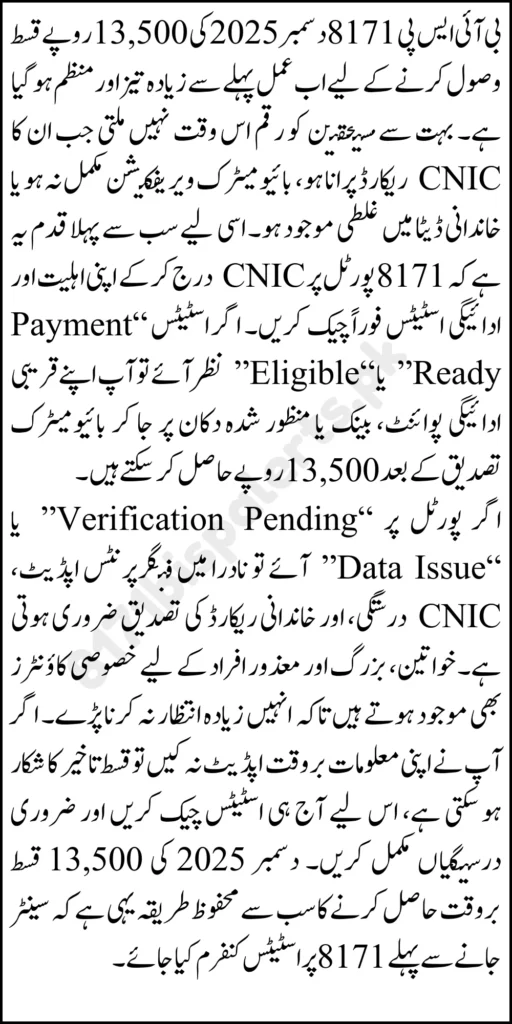
This system matters because it:
- reduces confusion about payment availability
- improves transparency through online status checking
- helps beneficiaries avoid unnecessary travel costs
- supports faster resolution of blocked or pending cases
- lowers the chance of fraud by encouraging official verification
When families understand the tracker, they can take the right action at the right time and avoid financial stress.
Who Can Use CNIC-Based Validation for 13,500 Payment
The tracker is for eligible beneficiaries linked to official records. CNIC validation is the central step because it confirms that the person checking the status matches the registered profile. Most cases involve women beneficiaries, but verification depends on the registered household profile.
You can use CNIC validation if:
- you have a valid CNIC that is not expired
- your household record is present in the system
- your contact details and family information match official records
- you comply with verification requirements like biometric checks when needed
- you do not have a disqualification flag or duplicate record issue
If your CNIC is expired or your household data is incomplete, the tracker can show pending or ineligible until you fix the record.
What the Rs. 13,500 Payment Represents for Families
The Rs. 13,500 BISP payment is a support installment meant to help low income families manage monthly essentials. Many households use it for food, children’s needs, bills, and medical expenses. The most important thing is to collect it safely and in full, without any illegal deductions.
People often search for 13500 payment status, BISP installment verification, and 8171 CNIC check because they want one clear answer: is the payment ready or not.
How to Check 8171 BISP Payment Status Using CNIC
CNIC-based validation is simple, but accuracy matters. A single digit mistake can show wrong results or no record.
Use this step by step method:
- keep your CNIC number ready and type it carefully
- use the official online status check method or official verification procedure
- submit your CNIC details for validation
- read the result and note your status message
- follow the instructions shown for collection or verification
- You are shown eligible, you move to payment collection. If you see pending verification, you need to update records. If you see blocked, you must resolve the reason through proper support channels.
Common Status Messages and What They Mean
Beneficiaries often get confused by short status messages. Understanding them helps you take the correct next step.
Common meanings include:
- Eligible: your payment is approved or in process
- Payment Ready: you can collect from the designated point after required verification
- Pending Verification: your record needs update or confirmation
- Biometric Required: you must verify fingerprints at collection or support point
- Ineligible: your current record does not meet criteria or needs review
- Blocked: there is a mismatch, duplicate record, CNIC issue, or security flag
These messages are not meant to scare you. They guide you toward the required action.
Why Payments Get Delayed Even When You Are Eligible
Sometimes beneficiaries are eligible but still see delays. This happens because payment release can depend on processing cycles and verification steps.
Common delay reasons include:
- biometric verification failure at payment site
- outdated CNIC record or family data mismatch
- heavy rush at payment centers causing system slowdown
- mobile number not linked to CNIC, causing missed updates
- verification pending due to household survey issues
- duplicate record detection requiring manual review
Most of these problems are solvable with careful verification and record correction.
Comparison of Verification Methods
| Method | Details |
|---|---|
| Official Online Portal Check | Use official guidance and updates: https://bisp.gov.pk |
| 8171 SMS CNIC Check | Send CNIC through the official SMS method for basic validation |
| Payment Center Biometric | Confirm identity through fingerprint scan to release Rs. 13,500 |
| Tehsil Office Verification | Resolve blocked status, survey issues, or record corrections |
| CNIC and SIM Link Update | Update CNIC or SIM ownership if details do not match records |
This table helps you choose the best verification route based on your situation.
How to Collect Your Rs. 13,500 Payment Safely
Once your payment is ready, the next step is safe collection. Many beneficiaries worry about scams or deductions, so follow these safety steps.
Safe collection checklist:
- carry your original CNIC
- collect payment only from an authorized channel
- complete biometric verification yourself
- count money before leaving the counter
- keep receipt or confirmation message safe
- do not share your CNIC photo or personal codes with strangers
- avoid agents who promise faster payment for a fee
If deductions happen, report immediately to the official staff present at the location.
How to Fix Biometric Verification Problems
Biometric failures are common, especially for elderly beneficiaries or people with faint fingerprints. Many cases are resolved by simple preparation.
Try these practical steps:
- wash hands and dry properly before scanning
- avoid applying lotion right before verification
- request an alternate finger scan if allowed
- retry when the machine is stable and clean
- if failure continues, update biometric information through the proper official channel
Once biometric verification matches, payment release becomes much smoother.
How to Fix CNIC or Data Mismatch Issues
If your tracker shows blocked or pending verification, the solution is usually record correction.
Common fixes include:
- renew CNIC if it is expired
- ensure your name spelling matches all records
- update family information if household data is outdated
- ensure your mobile number is registered under your CNIC
- address duplicate entries by completing verification at the proper office
Accuracy is the key. Even small mismatches can stop payments.
Best Practices to Stay Eligible for Future Payments
Staying eligible is easier than unblocking a case. If you maintain clean and updated records, you reduce issues and receive payments more regularly.
Best practices:
- keep CNIC valid and renewed on time
- keep household records accurate and consistent
- use one CNIC-linked mobile number for official updates
- respond quickly to verification or survey requests
- avoid sharing personal details with unknown people
- only trust official verification methods
These habits protect your BISP beneficiary status and prevent future payment blocks.
Why CNIC-Based Tracking Builds Trust and Transparency
CNIC validation adds a strong security layer. It helps ensure payments go to real beneficiaries rather than fake profiles. It also gives families a direct way to check their status without relying on rumors.
This system improves:
- confidence in payment fairness
- reduction in fraud or duplicate payouts
- faster handling of pending cases
- clearer communication with beneficiaries
- safer and more organized payment cycles
When people use the tracker correctly, they save time and avoid stress.
Final Words
The 8171 BISP Payment Tracker is one of the most useful tools for beneficiaries who want to confirm their Rs. 13,500 payment using reliable CNIC-based validation. It helps you check eligibility, understand status messages, fix verification issues, and collect payments safely. If you keep your CNIC valid, maintain accurate household records, and follow official verification steps, you can receive your payments smoothly without delays or deductions. Stay alert, stay verified, and always use official methods for the best results.
FAQs
1. How do I check my Rs. 13,500 payment through the 8171 tracker?
You can confirm your status using CNIC validation through official methods including online checks or the official SMS approach.
2. Why does my status show pending verification?
Pending verification usually means your data needs confirmation, such as household survey update, CNIC correction, or record matching.
3. What if my biometric verification fails at the payment center?
Clean and dry your fingers, retry with alternate fingers if allowed, and update biometric data through official channels if it keeps failing.
4. Can I receive payment if my CNIC is expired?
No, expired CNIC often blocks payment. Renew it first and then check your status again.
5. How can I avoid deductions during payment collection?
Collect from authorized locations, verify biometrics yourself, count your money on the spot, and do not pay any agent fees.
6. What does blocked status mean in the payment tracker?
Blocked status usually means a mismatch, duplicate entry, CNIC issue, or verification flag that requires record correction.
7. How do I stay eligible for the next payment cycle?
Maintain a valid CNIC, keep family data updated, use a CNIC-linked mobile number, and follow official verification instructions when requested.